


Photos are illustrative only.
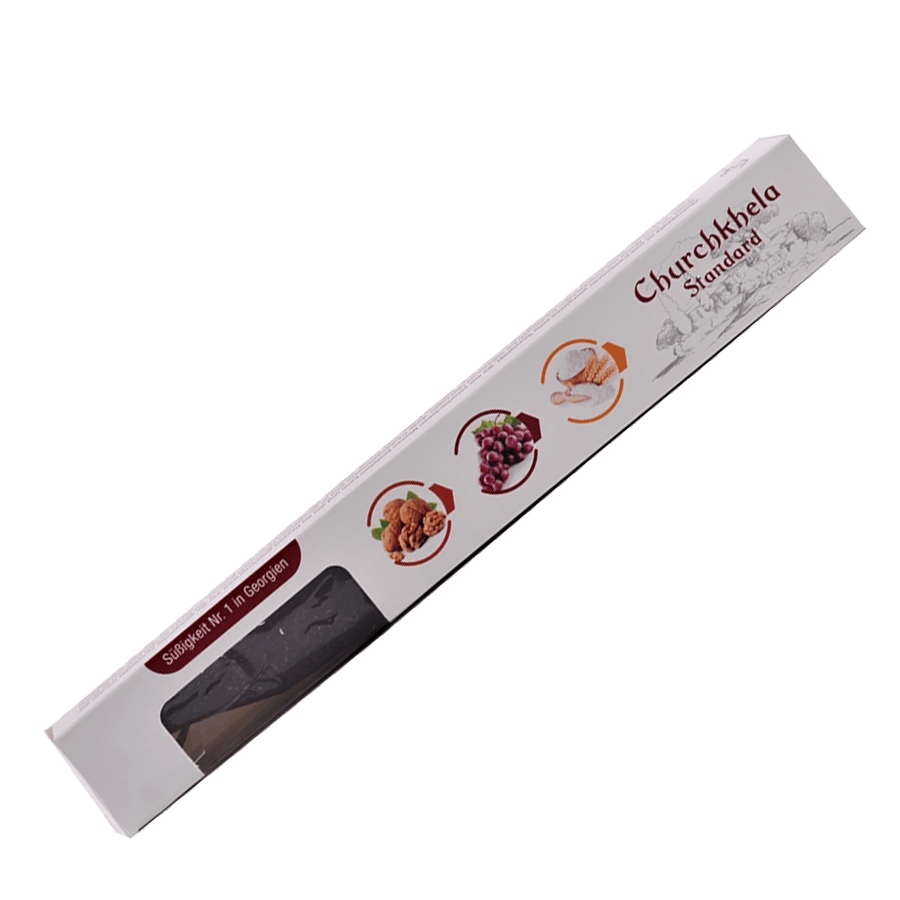
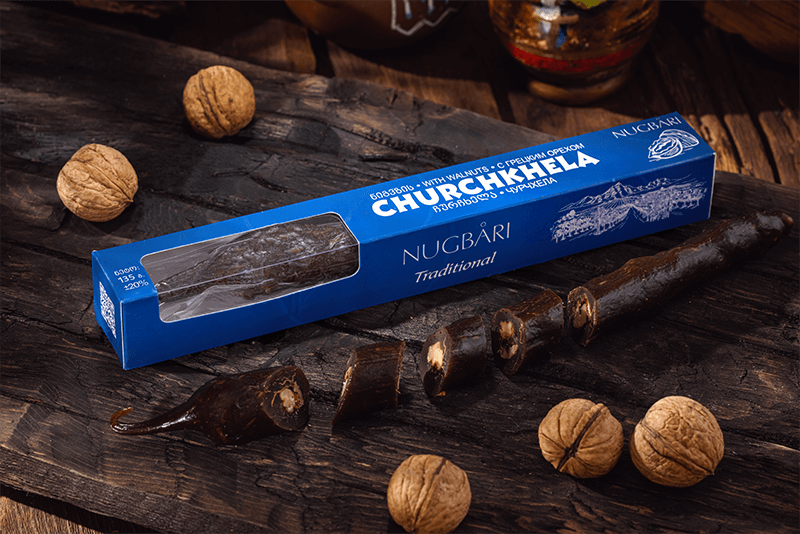
Churchkhela with Walnuts – Traditional Georgian Sweet – 145 g
Brand: NUGBARI
Georgian churchkhela with walnuts – traditional sweet with grape juice coating. No added sugar.
 Estimate delivery 21.04.–22.04.
  Free delivery from 199 EUR
5.00€
In stock


Why to purchase on e-shop deGeorgie.fr ?
Churchkhela with Walnuts – Traditional Georgian Sweet – 145 g
Churchkhela with Walnuts is a classic Georgian sweet, handmade from concentrated Rkatsiteli grape juice, whole walnut kernels, and wheat flour – with no added sugar, preservatives, or artificial colorings. Known for its rich fruity coating and chewy texture, this natural treat offers an authentic taste of Georgia’s culinary heritage.
The walnuts are carefully threaded by hand and repeatedly dipped into palouze, a warm, thickened grape juice cream. After forming a 1.5–2 cm layer, the churchkhela is air-dried for two weeks to achieve its traditional shape and consistency. The result is a delicious balance of nutty crunch and fruity depth, made without any industrial processing.
Perfect with tea, coffee, red wine, or even cheese, churchkhela is a satisfying and nutrient-rich snack, enjoyed by both adults and children. Passed down through generations, this handmade delicacy is now available throughout the EU – bringing the flavors of Georgia directly to your home.
Georgian sweets churchkhela
Churchkhela is a traditional Georgian sweet, often called the “Georgian snickers,” but it’s much more natural and historic than modern chocolate bars. It is made by dipping a string of walnuts (or sometimes hazelnuts or almonds) into a thickened grape juice mixture, then letting it dry. The result is a chewy, slightly tangy, and energy-rich snack.
Traditionally, churchkhela was prepared during the grape harvest season in autumn. Families made it in large quantities to store for the winter months. It was valued as a high-energy food for travelers and even warriors, since it could last a long time without spoiling. Today, churchkhela is eaten year-round, often as a snack with tea or offered to guests as a sign of hospitality.
For a French person, churchkhela could be compared to nougat from Montélimar, since both are nut-based and associated with festive occasions. However, unlike nougat (which is soft, sweet, and honey-based), churchkhela has a more rustic, chewy texture and a fruity taste from the grape must. You might also compare it to calissons d’Aix, in the sense that it’s a specialty tied to regional tradition and holidays.
In short, churchkhela is not just a sweet—it’s a cultural symbol that carries with it history, family traditions, and a strong connection to Georgia’s winemaking heritage.
Is churchkhela hard or soft?
- Churchkhela is firm on the outside but chewy inside.
- The grape juice coating dries into a slightly leathery layer that gives it firmness when you bite into it.
- Inside, the walnuts (or other nuts) provide crunch, so you get a mix of chewy and crunchy textures.
- It’s not as hard as candy, but not as soft as nougat either—more like dried fruit leather wrapped around nuts.
- Churchkhela is a bit like figues sèches farcies aux noix (dried figs stuffed with walnuts). You get that same chewy dried-fruit outside with a crunchy nutty core.
- It also has something in common with pâtes de fruits, but denser and less sweet, because the grape juice reduction gives it a natural tang rather than a sugary finish.
So, in short: imagine a mix between pâte de fruits and figues sèches aux noix, chewy, fruity, with a satisfying crunch.
How to eat churchkhela?
Here’s how churchkhela is usually eaten:
- Slice or bite: Traditionally, people just bite into it like a snack. But you can also cut it into small slices, which is easier to share and looks nice on a plate.
- With drinks: It’s often enjoyed with tea or coffee, or even with a glass of wine, since the grape flavor pairs well with both sweet and savory.
- As a snack or dessert: You can eat it on its own between meals, or serve it at the end of a meal alongside fruit and nuts.
- On festive tables: In Georgia, it’s common to cut churchkhela into pieces and put them on a platter with dried fruits, nuts, and sweets when guests come.
Think of it like how nougat or calissons might be served in France — either gifted, shared at holidays, or eaten with coffee after a meal.
Traditions and occasions
- Churchkhela is especially common during New Year and Christmas celebrations in Georgia.
- It’s often sold at markets, festivals, and by roadside vendors, making it not only a homemade delicacy but also a symbol of Georgian street food culture.
- In the past, it was also a common gift between families and friends during holidays.
- What is churchkhela made of
Churchkhela alcohol
Churchkhela itself is non-alcoholic – it’s made from thickened grape juice (called tatara in Georgia) and nuts, with no fermentation involved.
But there is a cultural link with alcohol:
- It’s often made during the grape harvest, alongside wine production. Families would use the leftover grape must (freshly pressed juice before fermentation) to prepare churchkhela, while the rest became wine.
- Because of that, churchkhela is traditionally eaten with wine at festive tables, almost like a natural snack that pairs with a glass of red.
- Some travelers even call it “wine candy,” though it contains no alcohol.
Is churchkhela vegan?
Yes — churchkhela is naturally vegan.
It’s made with just a few ingredients:
- grape juice (reduced and thickened, often with a little flour or starch),
- nuts (walnuts, hazelnuts, almonds),
- sometimes a touch of sugar or spices.
No honey, dairy, eggs, or animal products are used in the traditional recipe. That said, recipes can vary by region or family, so if it’s made commercially, it’s always smart to check the label. But in its authentic Georgian form, it’s 100% plant-based.
Where to buy churchkhela in France
Looking for something unique, natural, and full of tradition? At deGeorgie.fr, you can now enjoy Churchkhela, the legendary Georgian sweet that has delighted generations.
Made from walnuts carefully strung together and dipped in thickened grape juice, churchkhela is both delicious and nourishing. With its chewy fruit coating and crunchy nutty heart, it’s a treat that feels rustic, authentic, and satisfying — unlike any candy you’ve tasted before.
In Georgia, churchkhela is prepared during the grape harvest and shared with family and guests during festive holidays. Now, thanks to deGeorgie.fr, you can bring this tradition straight to your home in France.
Why choose churchkhela from deGeorgie.fr?
- 100% traditional recipe with natural ingredients
- Perfect as a snack, dessert, or gift
- A taste of Georgia’s winemaking culture
- Fast delivery across France: Paris, Lyon, Marseille, Bordeaux, Lille, Toulouse, Nice, Strasbourg… and everywhere in between!
Order your traditional walnut churchkhela today on deGeorgie.fr and discover why this sweet is a symbol of Georgian hospitality.
Churchkhela alternative names
Churchkhela is known mainly under that name, but in Georgia and neighboring regions you’ll sometimes hear alternative or descriptive names:
- Ch’urch’khela (ჩურჩხელა) – the original Georgian spelling.
- Georgian Snickers – a playful modern nickname, since it’s nutty, filling, and portable.
- Tatara – not exactly the same, but refers to the thickened grape must used to coat the nuts.
- Rdzis Tkhali (რძის ტყალი) – literally “fruit leather with nuts” in some dialectal/old contexts.
- In Armenia, a very similar sweet is called Sujukh / Sudzhuk (not to be confused with the sausage of the same name).
- In Turkey, you may find it under Cevizli Sucuk (“walnut sausage”) or Pestil Sucuk.
- In Greece, a related sweet is called Soutzoukos.
So while “churchkhela” is the Georgian original and most common international name, travelers might come across sujukh, soutzoukos, or cevizli sucuk depending on the country.
Net weight: 145 g ± 20%
Ingredients: Rkatsiteli grape juice 50% (65% concentrate, 35% water), walnuts 42%, premium wheat flour 8%
Allergens: Contains walnuts, wheat (gluten), sulfites. May contain traces of hazelnuts
Storage: Store between 0 °C and 22 °C, away from direct sunlight
Production date / Best before: Indicated near the barcode
Nutritional values per 100 g:
Energy: 2058 kJ / 491 kcal
Fat: 29.5 g (saturated: 8.9 g)
Carbohydrates: 43.9 g (sugars: 37.0 g)
Protein: 12.6 g
Salt: 0.05 g
Additional information
| Weight | 0.140 kg |
|---|---|
| Country of origin | Georgia |
| Brand | NUGBARI |
| Main content | walnuts |
| Producer | L.L.C. NUGBARI |
| Whole package | 36 pieces |
| Weight | 145 g |
You might also like


In stock
Original price was: 51.00€.48.00€Current price is: 48.00€.
